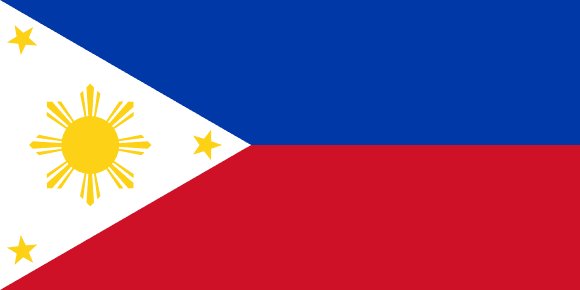
Administrative divisions of Philippines
The Philippines is divided into 118 first-level administrative divisions:
Largest cities in Philippines
| # | City | Population |
|---|---|---|
| 1 | Quezon City | 3,084,270 |
| 2 | Davao | 1,848,947 |
| 3 | Caloocan | 1,712,945 |
| 4 | ManilaCapital | 1,600,000 |
| 5 | Taguig | 1,308,085 |
| 6 | Budta | 1,273,715 |
| 7 | Malingao | 1,121,974 |
| 8 | Zamboanga | 1,018,849 |
| 9 | Cebu City | 965,332 |
| 10 | Antipolo | 913,712 |
Quezon City is the largest city in the Philippines with about 3,084,270 people; the capital, Manila, has about 1,600,000. All 144 largest cities of Philippines →
Terrain, rivers & lakes
Highest terrain in the Philippines: ≈ 4,128 m — read from the global elevation model, so summit heights are approximate. The physical map paints elevation bands from green lowlands to brown highlands.
🌊 Rivers
- Cagayan
🏞️ Lakes
- Laguna de Bay
- Lake Taal
Ethnic groups in Philippines
Tagalog 26%, Bisaya/Binisaya 14.3%, Ilocano 8%, Cebuano 8%, Illonggo 7.9%, Bikol/Bicol 6.5%, Waray 3.8%, Kapampangan 3%, Maguindanao 1.9%, Pangasinan 1.9%, other local ethnicities 18.5%, foreign ethnicities 0.2% (2020 est.)
Regionally, Tagalog is the most common ethnic group across most of the 118 divisions, while Bisaya/Binisaya predominates in 21 divisions (Zamboanga del Norte, Zamboanga del Sur, Zamboanga Sibugay, Misamis Occidental, Misamis Oriental, Cagayan de Oro, …); Ilocano predominates in 11 divisions (Ilocos Norte, Ilocos Sur, La Union, Abra, Apayao, Cagayan, …); Cebuano predominates in 9 divisions (Cebu, Mandaue, Lapu-Lapu, Bohol, Siquijor, Negros Oriental, …); Illonggo predominates in 8 divisions (Iloilo, Guimaras, Capiz, Bacolod, Negros Occidental, South Cotabato, …).
Source: CIA World Factbook (2020 est.) · regional dominance compiled by Glostats from censuses and surveys
Religions in Philippines
Roman Catholic 78.8%, Muslim 6.4%, Iglesia ni Cristo 2.6%, other Christian 3.9%, other 8.2%, none/unspecified <0.1 (2020 est.)
Regionally, Roman Catholic is the most common religious group across most of the 118 divisions, while Muslim predominates in 5 divisions (Sulu, Tawi-Tawi, Basilan, Lanao del Sur, Maguindanao).
Source: CIA World Factbook (2020 est.) · regional dominance compiled by Glostats from censuses and surveys
Languages in Philippines
Tagalog 39.9%, Bisaya/Binisaya 16%, Hiligaynon/Ilonggo 7.3%, Ilocano 7.1%, Cebuano 6.5%, Bikol/Bicol 3.9%, Waray 2.6%, Kapampangan 2.4%, Maguindanao 1.4%, Pangasinan/Panggalato 1.3%, other languages/dialects 11.2%, unspecified 0.4% (2020 est.)
Regionally, Tagalog is the most common language group across most of the 118 divisions, while Bisaya/Binisaya predominates in 21 divisions (Zamboanga del Norte, Zamboanga del Sur, Zamboanga Sibugay, Misamis Occidental, Misamis Oriental, Cagayan de Oro, …); Ilocano predominates in 11 divisions (Ilocos Norte, Ilocos Sur, La Union, Abra, Apayao, Cagayan, …); Cebuano predominates in 9 divisions (Cebu, Mandaue, Lapu-Lapu, Bohol, Siquijor, Negros Oriental, …); Hiligaynon/Ilonggo predominates in 8 divisions (Iloilo, Guimaras, Capiz, Bacolod, Negros Occidental, South Cotabato, …).
Source: CIA World Factbook (2020 est.) · regional dominance compiled by Glostats from censuses and surveys
Explore more
 India
 China
 Indonesia
 Pakistan
 Bangladesh
 Japan
 Vietnam
 Iran
Sources: boundaries, cities, rivers and lakes from Natural Earth (public domain, 1:10m); elevation from the AWS Open Data terrain tiles (SRTM/GMTED); ethnic, religious and language shares from the CIA World Factbook; regional dominance compiled by Glostats from national censuses and surveys. Page generated 2026-10-20. More about our data.