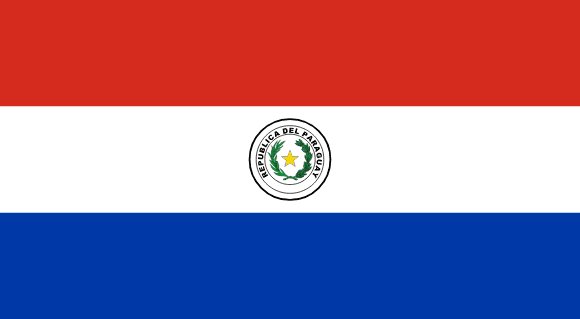
Quick facts
Paraguay population overview
Paraguay is the 9th most populous of 14 countries and territories in South America. The United Nations put the population at 7,055,427 on 1 January 2026; with an annual growth rate of +1.2% the live estimate on this page rises by roughly 222 people per day.
Over a full year that means about 134,053 births (19 per 1,000 people) and 40,921 deaths (5.8 per 1,000), and net emigration of roughly 11,994 people. The infant mortality rate is 15.2 per 1,000 live births.
World Bank data show the population grew from 1,883,514 in 1960 to 7,013,078 in 2025 — a change of +272.3%, or +2% per year on average. The population is at its all-time high today.
Demographically, the median age is 27.3 years; life expectancy at birth is 74.2 years; women have on average 2.4 children (2024, above the 2.1 replacement level); 28.4% of residents are under 15 and 6.7% are 65 or older (2025); 70.4% of people live in urban areas (2025).
The capital is Asuncion. Paraguay covers 406,752 km², giving a population density of about 17.5 people per km². GDP was $49.28B in 2025 — about $7,027 per person (World Bank classification: upper middle income).
Paraguay population statistics (2026)
| Population (live, October 2026) | 7,120,131 |
|---|---|
| UN estimate, 1 Jan 2026 | 7,055,427 |
| World rank | #108 of 238 |
| Rank in South America | #9 of 14 |
| Share of world population | 0.086% |
| Annual growth rate | +1.2% |
| Births per year est. | 134,053 |
| Deaths per year est. | 40,921 |
| Net migration per year est. | -11,994 |
| Birth rate | 19 per 1,000 |
| Death rate | 5.8 per 1,000 |
| Infant mortality | 15.2 per 1,000 births |
| Sex ratio | 100.5 males per 100 females |
| Median age | 27.3 years |
| Life expectancy | 74.2 years |
| Fertility rate 2024 | 2.4 births per woman |
| Urban population 2025 | 70.4% |
| Surface area 2023 | 406,752 km² |
| Population density | 17.5 per km² |
| Capital | Asuncion |
| GDP (current US$) 2025 | $49.28B |
| GDP per capita 2025 | $7,027 |
| Income group World Bank | Upper middle income |
Paraguay population by year
| Year | Population | Change | Annual growth |
|---|---|---|---|
| October 2026 (live, UN-based) | 7,120,131 | – | – |
| 2025 | 7,013,078 | +83,925 | +1.2% |
| 2024 | 6,929,153 | +85,007 | +1.2% |
| 2023 | 6,844,146 | +83,682 | +1.2% |
| 2022 | 6,760,464 | +76,282 | +1.1% |
| 2021 | 6,684,182 | +80,443 | +1.2% |
| 2020 | 6,603,739 | +444,636 | +1.4% |
| 2015 | 6,159,103 | +421,132 | +1.4% |
| 2010 | 5,737,971 | +289,874 | +1% |
| 2005 | 5,448,097 | +347,229 | +1.3% |
| 2000 | 5,100,868 | +521,062 | +2.2% |
| 1995 | 4,579,806 | +544,059 | +2.6% |
| 1990 | 4,035,747 | +525,076 | +2.8% |
| 1985 | 3,510,671 | +457,436 | +2.8% |
| 1980 | 3,053,235 | +361,587 | +2.6% |
| 1975 | 2,691,648 | +303,620 | +2.4% |
| 1970 | 2,388,028 | +262,851 | +2.4% |
| 1965 | 2,125,177 | +241,663 | +2.4% |
| 1960 | 1,883,514 | – | – |
Change and annual growth are measured against the previous row; growth is annualized where rows are five years apart. The live row extrapolates the UN estimate and is not directly comparable with the World Bank series.
About Paraguay
Population over time
- From 1,883,514 in 1960 to 7,120,131 today — up 278%.
- The population is at its all-time high right now.
- Average change over the last 10 years of data: +1.3% per year.
Life expectancy & fertility
- Life expectancy at birth: 74 years (2024), up 13.8 years since 1960.
- Fertility: 2.4 births per woman (2024) — above the ~2.1 replacement level.
Birth & death rates
- Latest: 19.7 births vs 5.7 deaths per 1,000 people (2024).
- Natural increase of 14 per 1,000 a year, before migration.
Age structure
- 28.4% of the population is under 15 and 6.7% is 65 or older (2025).
- The 65+ share has grown from 3.9% in 1960 — the population is aging.
CO₂ emissions
- Latest total: 8.03 Mt CO₂ (2024).
- Emissions peaked at 8.74 Mt in 2018 — down 8.2% since.
- Per person: 1.16 t in 2024, vs 0.27 t in 1970.
Energy use & renewables
- Energy use: 1,044 kg of oil equivalent per person (2023), up 37.1% since 1990.
- Renewables supplied 58.8% of final energy in 2021 (-19.7 points since 1990).
Forest area (% of land)
- Forest covers 38.5% of land area (2023).
- Net deforestation: cover fell from 64.3% to 38.5% since 1990 — roughly 104,754 km² of forest lost.
Urban population (% of total)
- 70.4% of people live in urban areas (2025), vs 35.6% in 1960 (+34.8 points).
- Became majority-urban around 1990.
Water resources & stress
- Water stress: low — freshwater withdrawals are 2.1% of renewable internal resources (2022, SDG 6.4.2-style bands).
- Renewable freshwater per person: 17,307 m³ in 2022, down 71.5% since 1961.
Economy
- GDP: $49.28B in 2025.
- Nominal GDP is up 36.1% since 2015.
- That works out to $7,027 per person.
Unemployment & inflation
- Unemployment: 4.8% of the labor force (2025, ILO estimate).
- Consumer-price inflation: 4% in 2025.
Internet & mobile
- 81.6% of people used the internet in 2024.
- Mobile subscriptions: 126.6 per 100 people (2023) — more subscriptions than people.
Paraguay in the news
Frequently asked questions
What is the population of Paraguay in 2026?
As of October 2026, Paraguay has an estimated population of 7,120,131. The United Nations estimated 7,055,427 residents on 1 January 2026; the live figure on this page extrapolates that estimate using the +1.2% annual growth rate.
Is the population of Paraguay growing or shrinking?
It is growing at +1.2% per year — roughly 222 more people every day. Each year there are about 134,053 births and 40,921 deaths, with net migration of -11,994.
What is the population density of Paraguay?
About 17.5 people per square kilometre: 7,120,131 people living on 406,752 km² of surface area (World Bank, 2023).
What is the median age in Paraguay?
The median age is 27.3 years, and life expectancy at birth is 74.2 years. 28.4% of the population is under 15 and 6.7% is 65 or older (2025).
How does Paraguay rank by population?
Paraguay is the 108th most populous of 238 countries and territories worldwide and the 9th in South America, with 0.086% of the global population.
How has the population of Paraguay changed over time?
In 1960 the population was 1,883,514; by 2025 it had grown to 7,013,078 (+272.3%). The year-by-year table above lists the full World Bank series.
Explore more
 Brazil
 Colombia
 Argentina
 Peru
 Nicaragua
 Kyrgyzstan
 Hong Kong
 Bulgaria
Sources & method: the live population is a linear extrapolation of the UN World Population Prospects estimate for 1 January 2026 using the annual growth rate (+1.2%); births, deaths and migration counters apply the UN crude rates to the live figure. Historical series, area, GDP and other indicators are from World Bank Open Data; the encyclopedic summary is from Wikipedia. Figures are statistical estimates, not census counts. Page generated 2026-10-19. More about our data.