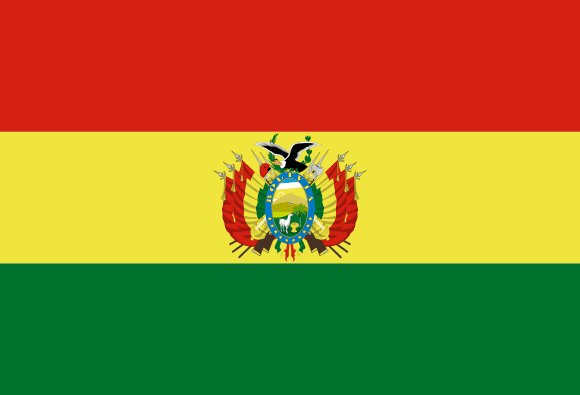
Administrative divisions of Bolivia
Bolivia is divided into 9 first-level administrative divisions:
Largest cities in Bolivia
| # | City | Population |
|---|---|---|
| 1 | Santa Cruz | 2,102,998 |
| 2 | La PazCapital | 1,590,000 |
| 3 | Cochabamba | 1,000,000 |
| 4 | Oruro | 246,501 |
| 5 | Santa Ana | 234,478 |
| 6 | Quillacollo | 227,052 |
| 7 | SucreCapital | 224,838 |
| 8 | Potosí | 179,901 |
| 9 | Tarija | 159,269 |
| 10 | Montero | 88,616 |
Santa Cruz is the largest urban area in Bolivia with about 2,102,998 people; the capital, La Paz, has about 1,590,000.
Terrain, rivers & lakes
Highest terrain in Bolivia: ≈ 6,555 m — read from the global elevation model, so summit heights are approximate. The physical map paints elevation bands from green lowlands to brown highlands.
🌊 Rivers
- San Martin
- Madre de Dios
- Pilcomayo
- Paraná
- Guaporé
- Beni
- Grande
- Yapacani
- Bermejo
- Mamoré
- Madeira
- San Miguel
🏞️ Lakes
- Lago Titicaca
- Lake
- Lago Concepción
- Laguna Huaitunas
- Laguna Ragaguado
- Lago Poopó
Ethnic groups in Bolivia
Mestizo (mixed White and Indigenous ancestry) 68%, Indigenous 20%, White 5%, Cholo/Chola 2%, African descent 1%, other 1%, unspecified 3%; 44% other Indigenous group, predominantly Quechua or Aymara (2009 est.)
Regionally, Mestizo is the most common ethnic group across most of the 9 divisions, while Indigenous predominates in 3 divisions (La Paz, Oruro, Potosí).
Source: CIA World Factbook (2009 est.) · regional dominance compiled by Glostats from censuses and surveys
Religions in Bolivia
Roman Catholic 65%, Protestant 19.6% (Evangelical (non-specific) 11.9%, Evangelical Baptist 2.1%, Evangelical Pentecostal 1.8%, Evangelical Methodist 0.7%, Adventist 2.8%, Protestant (non-specific) 0.3%), Believer (not belonging to the church) 0.9%, other 4.8%, atheist 1.7%, agnostic 0.6%, none 6.1%, unspecified 1.3% (2023 est.)
Regionally, Roman Catholic is the most common religious group across most of the 9 divisions.
Source: CIA World Factbook (2023 est.) · regional dominance compiled by Glostats from censuses and surveys
Languages in Bolivia
Spanish (official) 68.1%, Quechua (official) 17.2%, Aymara (official) 10.5%, Guarani (official) 0.6%, other 1.5%, unspecified 2.1%; note - Spanish and all Indigenous languages are official (2012 est.)
Regionally, Spanish is the most common language group across most of the 9 divisions, while Quechua predominates in 2 divisions (Potosí, Chuquisaca).
Source: CIA World Factbook (2012 est.) · regional dominance compiled by Glostats from censuses and surveys
Explore more
 Brazil
 Colombia
 Argentina
 Peru
 Venezuela
 Chile
 Ecuador
 Paraguay
Sources: boundaries, cities, rivers and lakes from Natural Earth (public domain, 1:10m); elevation from the AWS Open Data terrain tiles (SRTM/GMTED); ethnic, religious and language shares from the CIA World Factbook; regional dominance compiled by Glostats from national censuses and surveys. Page generated 2026-10-19. More about our data.