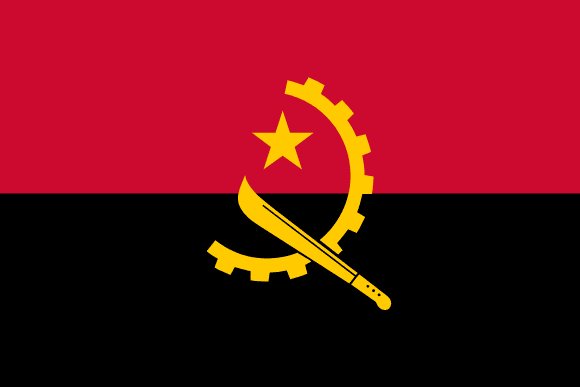
Administrative divisions of Angola
Angola is divided into 18 first-level administrative divisions:
Largest cities in Angola
| # | City | Population |
|---|---|---|
| 1 | LuandaCapital | 5,172,900 |
| 2 | Huambo | 1,100,000 |
| 3 | Lobito | 207,932 |
| 4 | Benguela | 151,226 |
| 5 | Moçâmedes | 132,900 |
| 6 | Malanje | 125,856 |
| 7 | Lubango | 125,632 |
| 8 | Kuito | 114,286 |
| 9 | Cabinda | 91,791 |
| 10 | Capenda-Camulemba | 80,000 |
Luanda is the largest urban area in Angola with about 5,172,900 people.
Terrain, rivers & lakes
Highest terrain in Angola: ≈ 2,573 m — read from the global elevation model, so summit heights are approximate. The physical map paints elevation bands from green lowlands to brown highlands.
🌊 Rivers
- Cubango
- Kwango
- Cunene
- Cuanza
- Cuando
- Congo
- Zambezi
- Lungwebungu
- Lucala
- Kasai
- Kwilu
- Inkisi
- Cuito
🏞️ Lakes
No major lakes at this scale.
Ethnic groups in Angola
Ovimbundu 37%, Kimbundu 25%, Bakongo 13%, Mestico (mixed European and native African) 2%, European 1%, other 22%
Regionally, Kimbundu is the most common ethnic group across most of the 18 divisions, while Ovimbundu predominates in 3 divisions (Huambo, Bié, Benguela); Bakongo predominates in 3 divisions (Cabinda, Zaire, Uíge); Chokwe predominates in 3 divisions (Lunda Norte, Lunda Sul, Moxico); Nhaneca predominates in 2 divisions (Huíla, Namibe).
Source: CIA World Factbook · regional dominance compiled by Glostats from censuses and surveys
Religions in Angola
Roman Catholic 41.1%, Protestant 38.1%, other 8.6%, none 12.3% (2014 est.)
Regionally, Roman Catholic is the most common religious group across most of the 18 divisions, while Protestant predominates in 2 divisions (Zaire, Uíge).
Source: CIA World Factbook (2014 est.) · regional dominance compiled by Glostats from censuses and surveys
Languages in Angola
Portuguese 71.2% (official), Umbundu 23%, Kikongo 8.2%, Kimbundu 7.8%, Chokwe 6.5%, Nhaneca 3.4%, Nganguela 3.1%, Fiote 2.4%, Kwanhama 2.3%, Muhumbi 2.1%, Luvale 1%, other 3.6% (2014 est.)
Regionally, Portuguese is the most common language group across most of the 18 divisions, while Chokwe predominates in 3 divisions (Lunda Norte, Lunda Sul, Moxico); Kimbundu predominates in 3 divisions (Malanje, Cuanza Norte, Bengo); Umbundu predominates in 2 divisions (Huambo, Bié); Kikongo predominates in 2 divisions (Zaire, Uíge).
Source: CIA World Factbook (2014 est.) · regional dominance compiled by Glostats from censuses and surveys
Explore more
 Nigeria
 Ethiopia
 Egypt
 DR Congo
 Tanzania
 South Africa
 Kenya
 Sudan
Sources: boundaries, cities, rivers and lakes from Natural Earth (public domain, 1:10m); elevation from the AWS Open Data terrain tiles (SRTM/GMTED); ethnic, religious and language shares from the CIA World Factbook; regional dominance compiled by Glostats from national censuses and surveys. Page generated 2026-10-19. More about our data.