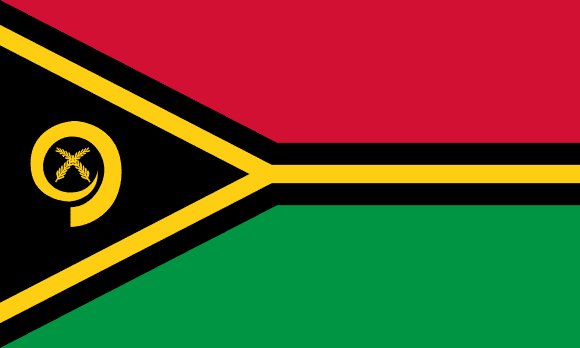
Administrative divisions of Vanuatu
Vanuatu is divided into 6 first-level administrative divisions:
Largest cities in Vanuatu
| # | City | Population |
|---|---|---|
| 1 | Port VilaCapital | 44,040 |
| 2 | Luganville | 13,397 |
Port Vila is the largest urban area in Vanuatu with about 44,040 people.
Terrain, rivers & lakes
Highest terrain in Vanuatu: ≈ 1,850 m — read from the global elevation model, so summit heights are approximate. The physical map paints elevation bands from green lowlands to brown highlands.
No major named rivers or lakes are mapped for Vanuatu at this map scale.
Ethnic groups in Vanuatu
Ni-Vanuatu 99%, other 1% (European, Asian, other Melanesian, Polynesian, Micronesian, other) (2020 est.)
Regionally, Ni-Vanuatu is the most common ethnic group across most of the 6 divisions.
Source: CIA World Factbook (2020 est.) · regional dominance compiled by Glostats from censuses and surveys
Religions in Vanuatu
Protestant 39.9% (Presbyterian 27.2%, Seventh Day Adventist 14.8%, Anglican 12%, Churches of Christ 5%, Assemblies of God 4.9%, Neil Thomas Ministry/Inner Life Ministry 3.2%), Roman Catholic 12.1%, Apostolic 2.3%, Church of Jesus Christ 1.8%, customary beliefs (including Jon Frum cargo cult) 3.1%, other 12%, none 1.4%, unspecified 0.1% (2020 est.)
Regionally, Protestant is the most common religious group across most of the 6 divisions.
Source: CIA World Factbook (2020 est.) · regional dominance compiled by Glostats from censuses and surveys
Languages in Vanuatu
indigenous languages (more than 100) 82.6%, Bislama (official; creole) 14.5%, English (official) 2.1%, French (official) 0.8% (2020 est.)
Regionally, indigenous languages is the most common language group across most of the 6 divisions.
Source: CIA World Factbook (2020 est.) · regional dominance compiled by Glostats from censuses and surveys
Explore more
 Australia
 Papua New Guinea
 New Zealand
 Fiji
 Solomon Islands
 New Caledonia
 French Polynesia
 Samoa
Sources: boundaries, cities, rivers and lakes from Natural Earth (public domain, 1:10m); elevation from the AWS Open Data terrain tiles (SRTM/GMTED); ethnic, religious and language shares from the CIA World Factbook; regional dominance compiled by Glostats from national censuses and surveys. Page generated 2026-10-19. More about our data.