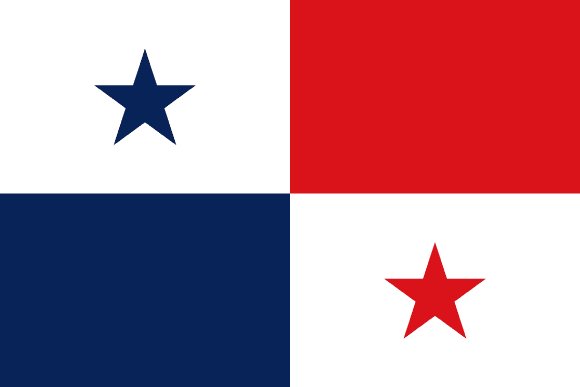
Administrative divisions of Panama
Panama is divided into 12 first-level administrative divisions:
Largest cities in Panama
| # | City | Population |
|---|---|---|
| 1 | Panama CityCapital | 1,281,000 |
| 2 | Colón | 204,000 |
| 3 | David | 110,037 |
| 4 | Balboa | 62,882 |
| 5 | Santiago | 45,955 |
| 6 | Chitré | 44,082 |
| 7 | Penonome | 28,766 |
| 8 | Puerto Armuelles | 27,147 |
| 9 | Las Tablas | 11,358 |
| 10 | Bocas del Toro | 9,883 |
Panama City is the largest urban area in Panama with about 1,281,000 people.
Terrain, rivers & lakes
Highest terrain in Panama: ≈ 3,444 m — read from the global elevation model, so summit heights are approximate. The physical map paints elevation bands from green lowlands to brown highlands.
🌊 Rivers
- Panama Canal
- Santa Mara
🏞️ Lakes
- Lago Gatun
Ethnic groups in Panama
Mestizo (mixed Indigenous and White) 65%, Indigenous 12.3% (Ngabe 7.6%, Kuna 2.4%, Embera 0.9%, Bugle 0.8%, other 0.4%, unspecified 0.2%), Black or African descent 9.2%, Mulatto 6.8%, White 6.7% (2010 est.)
Regionally, Mestizo is the most common ethnic group across most of the 12 divisions, while Indigenous predominates in 4 divisions (Kuna Yala, Emberá, Ngöbe Buglé, Bocas del Toro).
Source: CIA World Factbook (2010 est.) · regional dominance compiled by Glostats from censuses and surveys
Religions in Panama
Evangelical 55%, Roman Catholic 33.4%, none 10.1%, unspecified 1.5% (2023 est.)
Regionally, Evangelical is the most common religious group across most of the 12 divisions.
Source: CIA World Factbook (2023 est.) · regional dominance compiled by Glostats from censuses and surveys
Languages in Panama
Spanish (official), Indigenous languages (including Ngabere (Guaymi), Buglere, Kuna, Embera, Wounaan, Naso (Teribe), and Bri Bri), Panamanian English Creole (a mixture of English and Spanish with elements of Ngabere, also known as Guari Guari and Colon Creole), English, Chinese (Yue and Hakka), Arabic, French Creole, other (Yiddish, Hebrew, Korean,
Regionally, Spanish is the most common language group across most of the 12 divisions, while Kuna predominates in 1 division (Kuna Yala); Embera predominates in 1 division (Emberá); Ngabere predominates in 1 division (Ngöbe Buglé).
Source: CIA World Factbook · regional dominance compiled by Glostats from censuses and surveys
Explore more
 United States
 Mexico
 Canada
 Guatemala
 Haiti
 Dominican Republic
 Honduras
 Cuba
Sources: boundaries, cities, rivers and lakes from Natural Earth (public domain, 1:10m); elevation from the AWS Open Data terrain tiles (SRTM/GMTED); ethnic, religious and language shares from the CIA World Factbook; regional dominance compiled by Glostats from national censuses and surveys. Page generated 2026-10-19. More about our data.