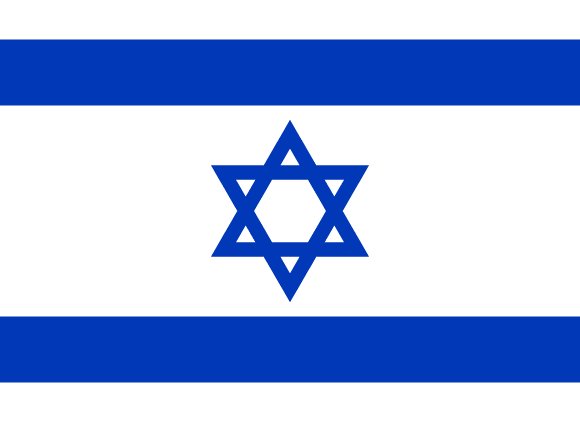
Administrative divisions of Israel
Israel is divided into 6 first-level administrative divisions:
Largest cities in Israel
| # | City | Population |
|---|---|---|
| 1 | Tel Aviv | 3,112,000 |
| 2 | JerusalemCapital | 1,029,300 |
| 3 | Haifa | 1,011,000 |
| 4 | Beer Sheva | 206,408 |
| 5 | Nazareth | 151,459 |
| 6 | Ramla | 63,860 |
Tel Aviv is the largest urban area in Israel with about 3,112,000 people; the capital, Jerusalem, has about 1,029,300.
Terrain, rivers & lakes
Highest terrain in Israel: ≈ 2,806 m — read from the global elevation model, so summit heights are approximate. The physical map paints elevation bands from green lowlands to brown highlands.
🌊 Rivers
- Jordan
🏞️ Lakes
- Sea of Galilee
- Dead Sea
Ethnic groups in Israel
Jewish 73.5% (of which Israel-born 79.7%, Europe/America/Oceania-born 14.3%, Africa-born 3.9%, Asia-born 2.1%), Arab 21.1%, other 5.4% (2022 est.)
Regionally, Jewish is the most common ethnic group across most of the 6 divisions, while Arab predominates in 1 division (HaZafon).
Source: CIA World Factbook (2022 est.) · regional dominance compiled by Glostats from censuses and surveys
Religions in Israel
Jewish 73.5%, Muslim 18.1%, Christian 1.9%, Druze 1.6%, other 4.9% (2022 est.)
Regionally, Jewish is the most common religious group across most of the 6 divisions.
Source: CIA World Factbook (2022 est.) · regional dominance compiled by Glostats from censuses and surveys
Languages in Israel
Hebrew (official), Arabic (special status under Israeli law), English (most commonly used foreign language)
Regionally, Hebrew is the most common language group across most of the 6 divisions, while Arabic predominates in 1 division (HaZafon).
Source: CIA World Factbook · regional dominance compiled by Glostats from censuses and surveys
Explore more
 India
 China
 Indonesia
 Pakistan
 Bangladesh
 Japan
 Philippines
 Vietnam
Sources: boundaries, cities, rivers and lakes from Natural Earth (public domain, 1:10m); elevation from the AWS Open Data terrain tiles (SRTM/GMTED); ethnic, religious and language shares from the CIA World Factbook; regional dominance compiled by Glostats from national censuses and surveys. Page generated 2026-10-19. More about our data.