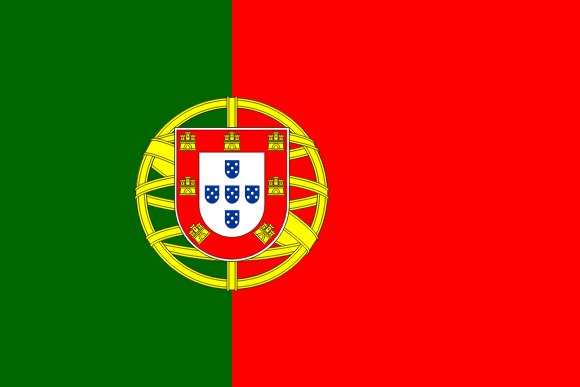
Administrative divisions of Portugal
Portugal is divided into 20 first-level administrative divisions:
Largest cities in Portugal
| # | City | Population |
|---|---|---|
| 1 | LisbonCapital | 2,812,000 |
| 2 | Porto | 1,337,000 |
| 3 | Braga | 826,833 |
| 4 | Funchal | 204,767 |
| 5 | Setúbal | 117,974 |
| 6 | Coimbra | 106,582 |
| 7 | Ponta Delgada | 61,526 |
| 8 | Portimão | 61,226 |
| 9 | Évora | 55,620 |
| 10 | Aveiro | 54,162 |
Lisbon is the largest urban area in Portugal with about 2,812,000 people.
Terrain, rivers & lakes
Highest terrain in Portugal: ≈ 1,990 m — read from the global elevation model, so summit heights are approximate. The physical map paints elevation bands from green lowlands to brown highlands.
🌊 Rivers
- Minho
- Tejo
- Duero
- Guadiana
🏞️ Lakes
No major lakes at this scale.
Ethnic groups in Portugal
Portuguese 95%; citizens from Portugal’s former colonies in Africa, Asia (Han Chinese), and South America (Brazilian) and other foreign born 5%
Regionally, Portuguese is the most common ethnic group across most of the 20 divisions.
Source: CIA World Factbook · regional dominance compiled by Glostats from censuses and surveys
Religions in Portugal
Catholic 68.1%, not applicable 12.9%, no religion 12.0%, no response 2.2%, Protestant 1.8%, other 1.0%; less than 1%: other Christians, Orthodox, Muslim (2021 est.)
Regionally, Catholic is the most common religious group across most of the 20 divisions.
Source: CIA World Factbook (2021 est.) · regional dominance compiled by Glostats from censuses and surveys
Languages in Portugal
Portuguese (official), Mirandese (official, but locally used)
Regionally, Portuguese is the most common language group across most of the 20 divisions.
Source: CIA World Factbook · regional dominance compiled by Glostats from censuses and surveys
Explore more
 Russia
 Germany
 United Kingdom
 France
 Italy
 Spain
 Ukraine
 Poland
Sources: boundaries, cities, rivers and lakes from Natural Earth (public domain, 1:10m); elevation from the AWS Open Data terrain tiles (SRTM/GMTED); ethnic, religious and language shares from the CIA World Factbook; regional dominance compiled by Glostats from national censuses and surveys. Page generated 2026-10-19. More about our data.