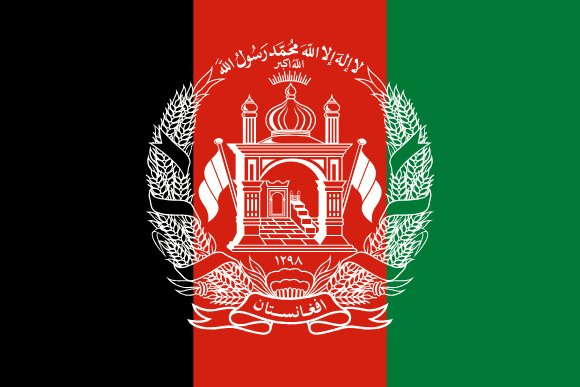
Administrative divisions of Afghanistan
Afghanistan is divided into 34 first-level administrative divisions:
Largest cities in Afghanistan
| # | City | Population |
|---|---|---|
| 1 | KabulCapital | 3,277,000 |
| 2 | Kandahar | 715,542 |
| 3 | Jalalabad | 597,971 |
| 4 | Herat | 481,009 |
| 5 | Mazar-i-Sharif | 458,151 |
| 6 | Kondoz | 259,809 |
| 7 | Baghlan | 218,748 |
| 8 | Lashkar Gah | 201,546 |
| 9 | Meymaneh | 199,795 |
| 10 | Balkh | 179,969 |
Kabul is the largest urban area in Afghanistan with about 3,277,000 people.
Terrain, rivers & lakes
Highest terrain in Afghanistan: ≈ 6,859 m — read from the global elevation model, so summit heights are approximate. The physical map paints elevation bands from green lowlands to brown highlands.
🌊 Rivers
- Pamir
- Panj
- Amu Darya
- Helmand
- Harirud
🏞️ Lakes
No major lakes at this scale.
Ethnic groups in Afghanistan
current, reliable statistical data on ethnicity in Afghanistan are not available; Afghanistan's 2004 Constitution cited Pashtun, Tajik, Hazara, Uzbek, Turkman, Baluch, Pashaie, Nuristani, Aymaq, Arab, Qirghiz, Qizilbash, Gujur, and Brahwui ethnicities; Afghanistan has dozens of other small ethnic groups
Regionally, Pashtun is the most common ethnic group across most of the 34 divisions, while Tajik predominates in 9 divisions (Badakhshan, Takhar, Balkh, Badghis, Hirat, Parwan, …); Uzbek predominates in 4 divisions (Jawzjan, Faryab, Sari Pul, Samangan); Hazara predominates in 1 division (Bamyan); Aymaq predominates in 1 division (Ghor).
Source: CIA World Factbook · regional dominance compiled by Glostats from censuses and surveys
Religions in Afghanistan
Muslim 99.7% (Sunni 84.7 - 89.7%, Shia 10 - 15%), other <0.3% (2009 est.)
Regionally, Muslim is the most common religious group across most of the 34 divisions.
Source: CIA World Factbook (2009 est.) · regional dominance compiled by Glostats from censuses and surveys
Languages in Afghanistan
Afghan Persian or Dari (official, lingua franca) 77%, Pashto (official) 48%, Uzbeki 11%, English 6%, Turkmani 3%, Urdu 3%, Pashaie 1%, Nuristani 1%, Arabic 1%, Balochi 1%, other <1% (2020 est.)
Regionally, Pashto is the most common language group across most of the 34 divisions, while Afghan Persian or Dari predominates in 13 divisions (Badakhshan, Takhar, Kunduz, Balkh, Badghis, Hirat, …); Uzbeki predominates in 4 divisions (Jawzjan, Faryab, Sari Pul, Samangan); Nuristani predominates in 1 division (Nuristan).
Source: CIA World Factbook (2020 est.) · regional dominance compiled by Glostats from censuses and surveys
Explore more
 India
 China
 Indonesia
 Pakistan
 Bangladesh
 Japan
 Philippines
 Vietnam
Sources: boundaries, cities, rivers and lakes from Natural Earth (public domain, 1:10m); elevation from the AWS Open Data terrain tiles (SRTM/GMTED); ethnic, religious and language shares from the CIA World Factbook; regional dominance compiled by Glostats from national censuses and surveys. Page generated 2026-10-19. More about our data.